A Figures of Speech poster came to the bench. We didn't add a frame to it, we let the frame finish the sentence.
Virgil Abloh's design language was always about punctuation as art, quotation marks around ordinary objects, the word "SCULPTURE" stamped on a ceramic vase, "SHOELACES" written on shoelaces. The point was never the lettering itself. The point was that the lettering changed how you saw the object underneath. So when a 2019 Figures of Speech poster from the MCA Chicago retrospective came in for framing, the question wasn't what frame goes around this. It was what frame keeps speaking the same language.
What came to the bench.
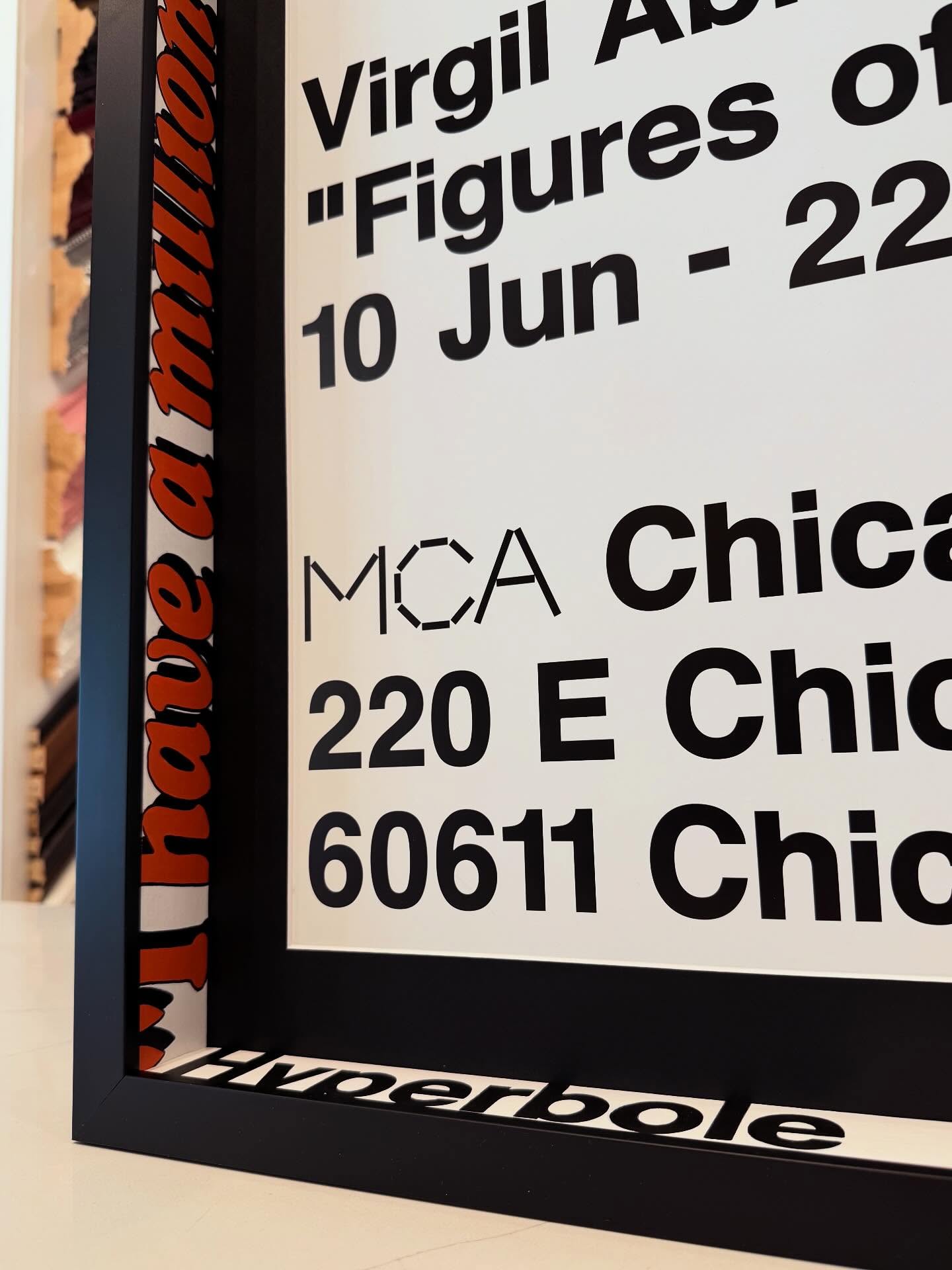
An exhibition poster, larger than a standard print, in heavy stock. Dense black-and-white typography across the face, exhibition title, dates, the MCA's stenciled logotype, the Chicago address in oversized numerals. The kind of object that lives in two registers at once: it's a piece of museum print collateral and it's a piece of Virgil's design output. The owner wanted both registers visible. They didn't want a clean white-mat museum frame that would let the poster sit politely behind glass. They wanted the frame to feel like Virgil could have specced it himself.
Make the frame keep talking.
Two design choices, both deliberate. First, the outer moulding: a textured matte black, slightly irregular under the light, closer to industrial cast iron than to gallery-finish lacquer. Virgil's Off-White hardware language, brought to a frame profile. No bevels, no decoration, no warmth. The black is meant to read as structural, not ornamental.
Second, the inner edge, the small reveal between the artwork and the outer moulding, where most frames hide a thin neutral fillet. We made that the loud part. Hot Off-White-orange, custom-mixed to the specific saturation Virgil used on his quotation tags, with a single line of his signature lettering running around the inside of the frame: a phrase from his own design vocabulary, looping back into the picture instead of stopping at it.
How we built it.
Conservation glazing first, UV-blocking museum acrylic, not glass. The poster is 2019 pigment on heavy stock, and the owner wants this hung in a south-facing room. Anything less than UV-blocking is a slow death sentence for the inks.
The mat is hidden. The poster sits float-mounted on Japanese-tissue hinges to acid-free backing, with the deckled paper edges left visible inside the inner reveal, no window cut, no border. The frame's inner orange edge is the only "mat" in the piece. That's intentional: a window mat would have read as a museum gesture. This isn't a museum frame. It's a designer's frame for a designer's poster.
The custom inner edge took three passes. First pass laid down the orange base in two thin coats of low-sheen enamel. Second pass set the lettering, printed onto a paper-thin foil and laid into the orange under the acrylic, with the quotation typography sized to the poster's own type at the edges so the eye reads it as continuous. Third pass sealed everything against the acrylic so nothing shifts in transit or under temperature swing.
Frames have a default setting: politely disappear. Sometimes the right move is the opposite, let the frame speak the same language as the work, so the picture doesn't end at the inner edge.
From the workshop bench
How it reads.
From across the room, the poster doesn't read as a framed object. It reads as one continuous design system, exhibition signage, typographic frame, Chicago context. The lettered inner edge sits low enough in saturation that it doesn't shout against the poster face, but bright enough that you notice it the second time you walk past. The owner sent a photo of the piece hanging two weeks after pickup. It's in a hallway between two doorways. The orange is the first thing you see when you turn the corner.
This frame is one-of-one. We documented every spec, pigment mix, font size, foil placement, mounting hinge layout, so it can be reproduced if the owner ever splits the collection. The next Figures of Speech poster that comes through won't get a copy of this frame. That one needs its own brief.